

Strategic Sourcing
Right price. Right amount. Right supplier.
Price negotiation and demand management on direct and indirect spend. Former consultants and industry practitioners, with access to a very large network of experts, work side by side with your team.
What we do
We lower the total cost of what you buy, goods or services, direct or indirect, and equip your team to keep delivering more.
Specification
Buy what the work needs, not what was bought last time. We test specifications, grades and service levels against how the product or service is actually used, and remove cost nobody would choose to pay.
Demand
Buy only what you need, when you need it. We consolidate volumes across sites and budgets, standardize where variety adds nothing, and match purchasing to how the business really runs.
Suppliers
Test the market and keep the relationships worth keeping. We map who can supply, run competitive events where they pay off, and consolidate where scale earns a better deal.
Price
Negotiate from facts, not last year's invoice. We build should-cost models and benchmarks with our expert network, then sit at the table beside your team.
Terms
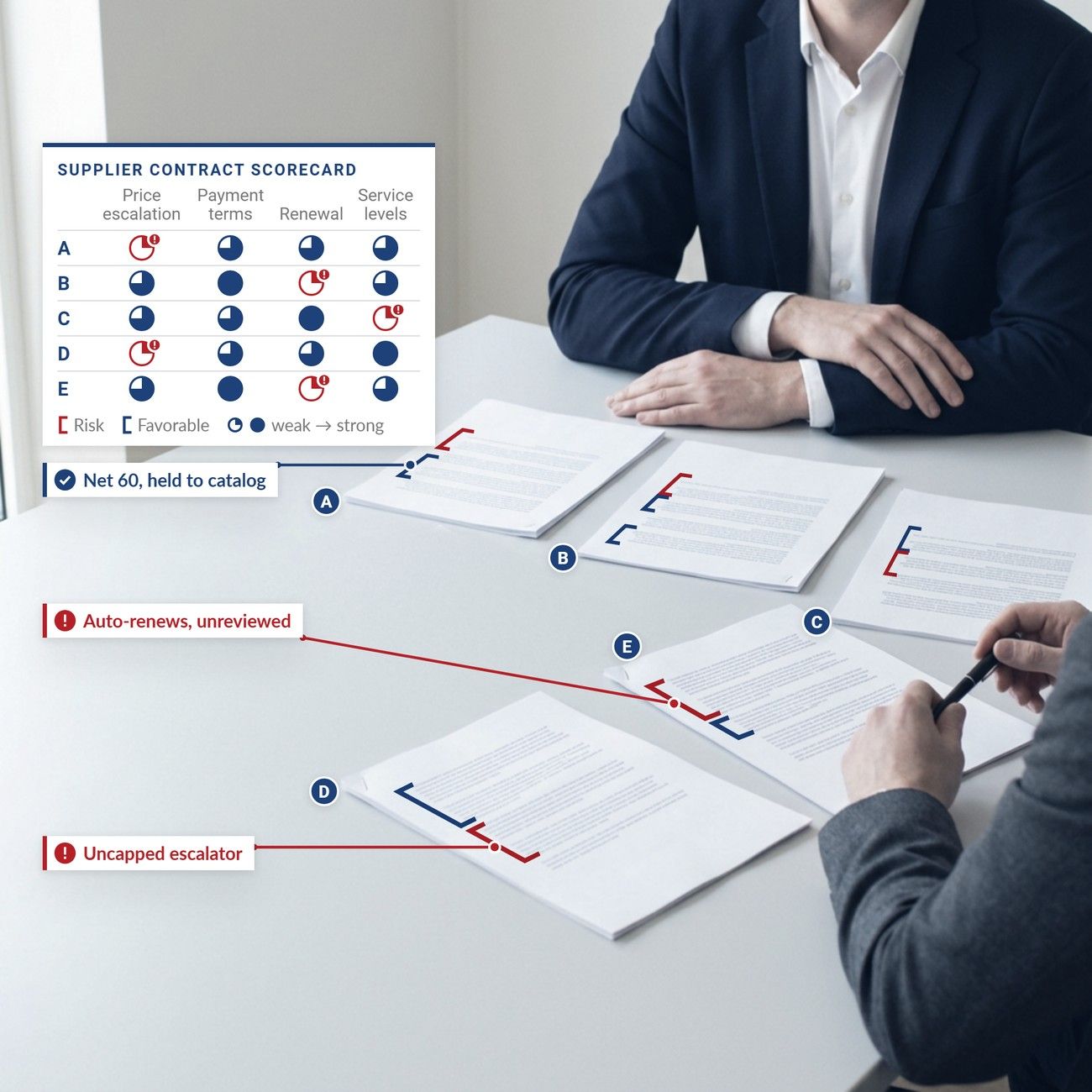
Make the savings hold. Payment terms, service levels, rebates and contract protections keep prices in place and free up cash, and compliance checks keep spend on contract.
One discipline across every line of spend, from raw materials to the services around them.
Need a procurement leader now? Interim Executives
From spend data to signed contracts
An assessment in 6–12 weeks, category waves over 4–8 months, then supplier management that keeps going.
Assess
Find where the savings are.
An enterprise-wide view of spend by vendor, commodity and business unit, with your executives, operators and key suppliers interviewed.
Every opportunity prioritized by spend, savings potential and ease of implementation, in a plan with costs and timing.
Go to market
Give every category a real choice.
Global supplier research, low-cost countries included, and one category profile in place of separate RFIs, RFPs and RFQs.
Specifications and volumes are challenged before a price is asked for.
Negotiate and award
Win on price, award on total cost.
Negotiations prepared and rehearsed, with reverse auctions where the category suits them.
Suppliers selected on total cost of ownership, not price alone.
Manage suppliers
Make sure the savings arrive.
New supplier alliances put in place with your category teams, and every agreement tracked for compliance and results.
We are done when your team can manage the relationships on its own.
Every saving, on price and on volume, is measured against the day-one baseline.
Two levers: price and demand
Spend is price times quantity, and we work both: what you pay for every unit, and how many units the business actually needs.
Spend today
Price per unit × quantity bought.
Price negotiation
Pay less for every unit: each category taken to market and negotiated.
Demand management
Buy the right amount: quantity, specification and frequency set to what the business needs.
Spend after
Both levers at once shrink spend from two sides.
Illustrative; no client data.
Your team runs the next round.
Our job is not done until the new suppliers are in place, results can be tracked, and your category team can manage the relationships on its own. You keep a spend baseline, a tracked set of agreements, and a team that knows how to take the next category to market.
Most of our fee depends on the results you realize.
Sourcing is one lever in a wider program: Performance Accelerated