

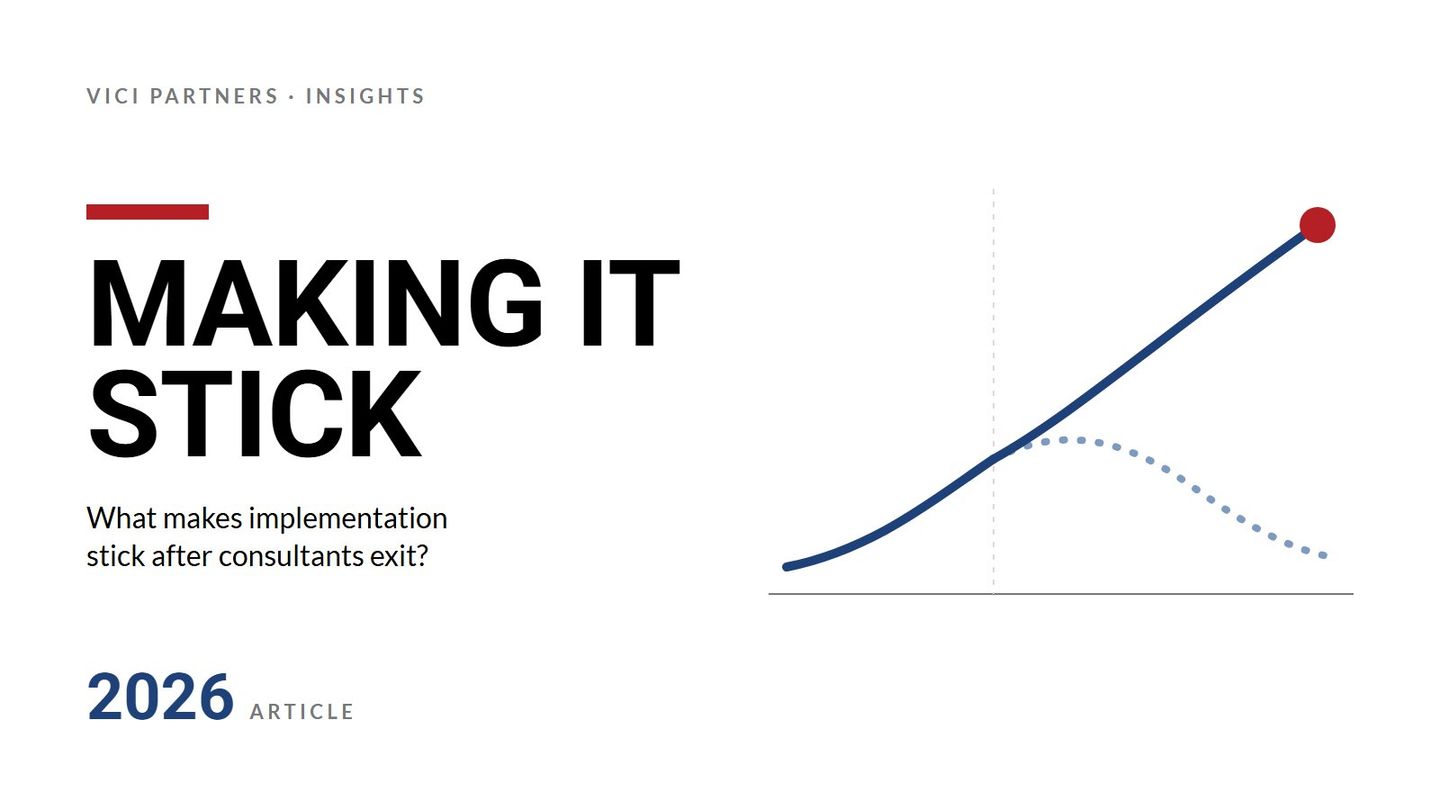
Most strategies don’t fail – they fade.
Energy drops.
Ownership blurs.
The next urgent issue takes priority.
And six months later, the financial impact has stalled.
The uncomfortable truth?
Execution failure rarely happens overnight. It happens quietly.
So what separates initiatives that compound from those that regress?
Here’s what we’ve seen consistently make the difference.
Clear ownership
“If everyone owns it” sounds collaborative.
It isn’t.
Durable implementation requires:
- One accountable owner
- Defined metrics
- Authority to act
- A weekly review cadence
When someone’s name is attached to the outcome, behavior changes. When ownership is shared loosely, momentum slips.
Incentive alignment
Companies say they want transformation.
But if KPIs and compensation still reward legacy behavior, the old model wins.
People follow incentives. Not speeches.
When compensation reinforces the new operating discipline (pricing rigor, cost control, cross-functional execution), implementation accelerates and sustains.
Simplified complexity
The initiatives that last usually simplify the business.
Fewer decision layers.
Cleaner workflows.
Clearer reporting.
If the new model adds friction, it won’t survive.
If it removes friction, it compounds.
Weekly financial visibility
Task completion doesn’t sustain momentum.
Financial results do.
The companies that see durable impact review:
- Margin expansion
- Cash flow improvement
- Cost reduction realization
Weekly.
Not annually. Not “when the project closes.”
When financial impact is visible and recurring, the behavior sticks.
Embedded capability
The real test is simple:
“If the consultants left tomorrow, would this continue?”
Sustainable improvement requires building internal muscle, not consultant dependency.
That means:
- Teaching teams how to build business cases
- Embedding execution into operating rhythm
- Reinforcing financial discipline at every level
When the system works without outside pressure, it lasts.
How Vici makes implementation stick
Execution discipline is engineered.
Here’s how we embed it into operating cadence:
Anchor cadence to structured business cases, with built-in buy-in
Line leaders don’t just receive initiatives. They build and own them. Our web-based system guides teams through business case development and stakeholder consensus so commitment happens before execution begins.
Replace static decks with real-time visibility
Implementation isn’t tracked in PowerPoints. Vici’s software provides real-time reporting across the full earnings program (including financial impact), allowing leaders to re-budget, course-correct, and hold line accountability as results materialize.
Make continuous improvement the default
Through integrated training and a repeatable framework, we embed an ongoing improvement model into operating rhythm, turning what could be a one-time project into a scalable discipline across the organization.
Execution isn’t a presentation.
It’s a system.
Frontline highlight: distribution case study
In our work with a national distribution business operating in a regulated environment, margin pressure was intensifying due to government reimbursement cuts.
At first glance, it looked like a macro problem.
The breakthrough came from operational discipline, not a boardroom strategy session.
Branch leaders and frontline managers helped identify over 100 cost and revenue improvement initiatives. Service level roles were streamlined. Procurement spend was reduced across 20+ categories. Warehouses were consolidated. Delivery routes optimized. The invoicing system was modified to capture allowable revenue that had previously been missed.
None of it was flashy.
But it was owned locally. Measured weekly. Reinforced by leadership.
The result:
- Ideas identified to improve operating income by 90%
- Over 100 initiatives implemented
- Ability to withstand reimbursement cuts
- A strengthened culture of continuous improvement
- Ultimately positioning the company for a successful IPO
That’s what happens when implementation is embedded, not announced.
The bottom line
When capital is expensive, disciplined execution becomes your advantage.
Sustained implementation drives margin expansion and funds growth internally.
Strategy sets direction.
Execution builds enterprise value.